Using panels
Open, close, detach, resize
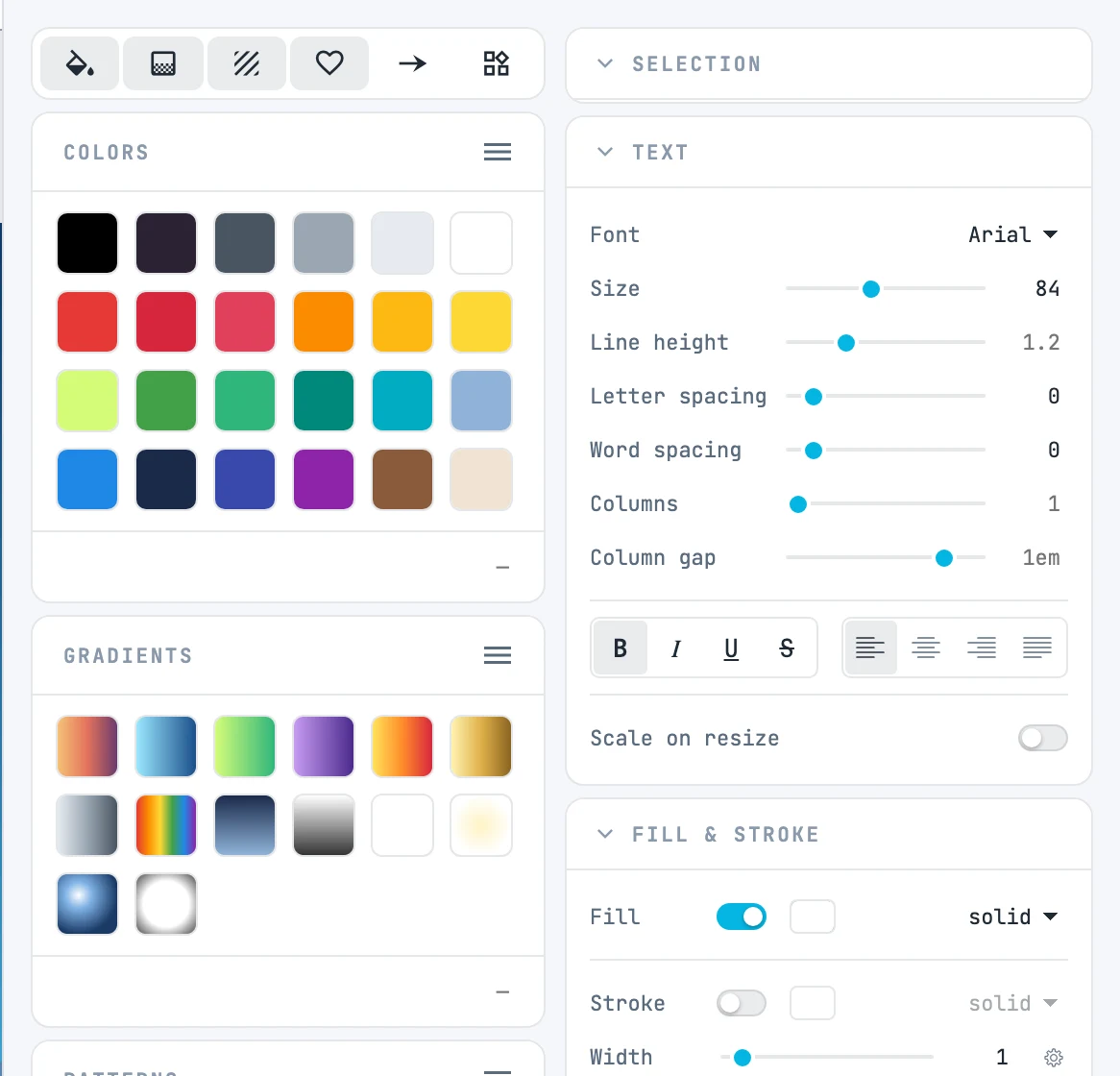
A panel header
| Element | What it does |
|---|---|
| Arrow on the left | collapses and expands the panel content (the header stays) |
| Name | you drag it: the panel detaches from the column and floats above the canvas |
| Header buttons | some panels have their own commands: the ≡ menu, the + to add, the two reflect buttons of Geometry |
| × | on a floating panel, puts it back in its column; in the column it is not there |
When floating, a panel is resized from the grip in the bottom-right corner. Put back in the column, it takes the column width again.
Resource panels
Gradients, Patterns, Symbols, Markers, Colors, Fonts, Widgets, and Trace image start hidden and, when opened, are already floating to the left of the column, over the canvas. The × hides them; reopened, they return where they were. The resource bar button stays on as long as the panel is open.
Tool bars and panels
A tool's options appear below the toolbar. Some stay as long as the tool is active (Pencil, Pen, polygon); others open when you hover over them with the mouse and close when you move away: the arc modes, the brush list, alignment, and snapping. You can detach the brush list by dragging its header, and it then stays open.
Panel menus
Menus that open from a field (color picker, angle wheel, stroke style and dashes, the four corners) close by themselves when the pointer moves away, after a quarter of a second. They stay open as long as you hold down a mouse button or type in one of their fields. Command menus close when you click outside or choose an item.
Enter a value
In numeric fields you type a number in the unit shown and confirm it with Enter or by leaving the field: each confirmation is one undo step. Dragged sliders show a live preview, and on release make a single step.